
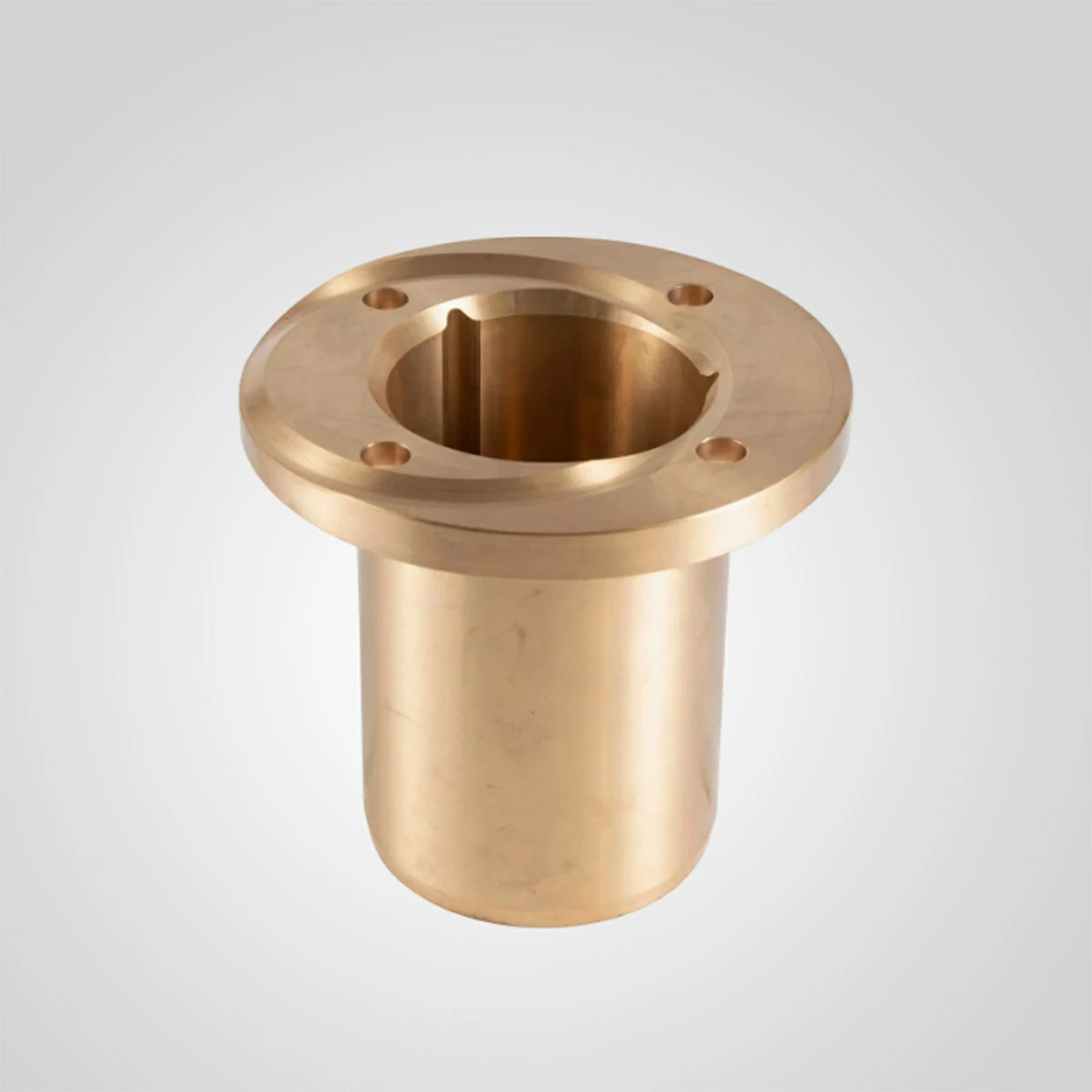
Part 1022061401 Countershaft Bushing — Metso Nordberg HP200 Cone Crusher
OEM Reference Part Number: 1022061401
Part Name :Countershaft Bushing (Horizontal Shaft Bushing / Flanged Bronze Bushing)
Compatible Machine :Metso Nordberg HP200 Cone Crusher
Net Weight :7.5 kg (OEM listed) / 7.86 kg (manufactured weight including finish)
Quantity per Machine :2 (one at pulley end, one at pinion gear end)
Material Grade: High-Lead Bronze — C93800 / SAE 660 (centrifugal casting grade)
Manufacturing Process: Centrifugal casting + CNC finish machining
Surface Hardness :55 – 70 HBW (bore / journal contact surface)
Dimensional Tolerance (Bore) :±0.015 mm (ISO h6)
| OEM Reference Part Number | 1022061401 |
| Part Name | Countershaft Bushing (Horizontal Shaft Bushing / Flanged Bronze Bushing) |
| Compatible Machine | Metso Nordberg HP200 Cone Crusher |
| Net Weight | 7.5 kg (OEM listed) / 7.86 kg (manufactured weight including finish) |
| Quantity per Machine | 2 (one at pulley end, one at pinion gear end) |
| Material Grade | High-Lead Bronze — C93800 / SAE 660 (centrifugal casting grade) |
| Manufacturing Process | Centrifugal casting + CNC finish machining |
| Surface Hardness | 55 – 70 HBW (bore / journal contact surface) |
| Dimensional Tolerance (Bore) | ±0.015 mm (ISO h6) |
| Surface Finish (Bore) | Ra ≤ 1.6 μm |
| Radial Running Clearance (Bore vs. Shaft Journal) | 0.05 – 0.10 mm (industry standard for HP200-class countershaft) |
| Maximum Bore Wear Limit | Replace when clearance exceeds 0.20 mm |
| Maximum Operating Temperature | 90°C at countershaft box oil return; investigate above this threshold |
| Lubrication Type | Separate pool lubrication in countershaft box (ISO VG 220 gear oil) |
| Inspection Interval | Oil sample every 300 hours; bore measurement at every scheduled liner change |
| Machine Drive Power | 149 kW (200 HP) |
| Countershaft Operating Speed | Approximately 750 – 950 RPM (model-dependent pulley ratio) |
| Applicable Standards | ASTM B584, ISO 9001:2015 |
The Countershaft Bushing That Runs at 900 RPM While Your Eccentric Turns at 300 — and Why It Fails Three Times Faster Than Any Other Bronze Component in the HP200
The Metso Nordberg HP200 countershaft rotates at approximately 750–950 RPM depending on the V-belt pulley ratio installed — two to three times the rotational speed of the eccentric assembly. Part number 1022061401 is the countershaft bushing that supports this shaft at each end of the countershaft box, and its bore surface accumulates sliding contact cycles at a rate that makes it the highest-frequency wear component in the entire HP200 bronze package. At 900 RPM, the bushing bore experiences over 1.3 million contact cycles per day. Under correct oil pool lubrication with ISO VG 220 gear oil in the countershaft box, this cone crusher bronze part maintains a stable hydrodynamic film and wears predictably over 4,000–8,000 operating hours. Under incorrect clearance, contaminated oil, or oil that has been left unchanged beyond its service interval, it fails to a bearing seizure — a condition field engineers call burnout — within 200–500 hours, damaging the countershaft journal surface in a way that requires precision grinding or full shaft replacement at USD 15,000–28,000 on a 200 HP class machine.
Two bushings are installed per HP200 — one at the drive pulley end and one at the pinion gear end. The pinion-end bushing carries the higher load, because the mesh force from the bevel gear set acts on that end of the countershaft, adding a bending moment to the radial journal load. In practice, the pinion-end bushing fails first and fails more severely when lubrication conditions are marginal, and a plant that has found one seized bushing at the pinion end without inspecting the pulley-end bushing has left half the problem in place for the next failure event.
Component Position and Load Characteristics: Why the Countershaft Bushing Demands the Most Attention of Any HP200 Bronze Part
The HP200 countershaft assembly transmits drive power from the V-belt pulley, through the shaft, to the bevel pinion gear that meshes with the eccentric bevel gear. The two countershaft bushings support the shaft radially within the countershaft box housing. Unlike the eccentric bushing or the socket liner — which experience relatively low rotational speeds — the countershaft bushing operates at the input speed of the drive system, before the gear reduction between pinion and ring gear reduces the eccentric speed.
At 149 kW drive power and 900 RPM, the surface velocity at the bushing bore is approximately 3–5 m/s depending on shaft diameter — significantly higher than the 0.5–1.2 m/s surface velocity at the eccentric bushing bore. This higher surface velocity requires a thinner, more stable oil film and demands cleaner oil than the eccentric circuit. The countershaft box uses a separate pool lubrication system — independent from the main pressurized lubrication circuit that serves the eccentric, head ball, and step bearing. Oil in the countershaft box is not continuously filtered and cooled. It relies on the thermal capacity of the oil volume and the natural radiation from the countershaft box casting to maintain temperature below the 90°C action threshold. When the oil is not changed on schedule — every 2,000 operating hours or 12 months, whichever comes first on an HP200 — oxidation products accumulate and the oil’s viscosity index deteriorates, reducing its ability to form a stable film at the bushing bore surface velocity.
Material Specification: The Role of Lead Content in a High-Speed Bronze Bushing
C93800 high-lead bronze (approximately 15% lead, 7% tin, balance copper) is specified for the HP200 countershaft bushing because the emergency lubrication function of the lead phase is more critical at 900 RPM than at the lower speeds of the eccentric assembly. During each startup, the countershaft accelerates from zero to operating speed in approximately 4–8 seconds. During this acceleration phase, the hydrodynamic film has not yet formed at full operating thickness. The lead particles distributed through the C93800 matrix smear onto the countershaft journal surface and provide a sacrificial anti-galling film during this boundary lubrication window. Without adequate lead content, every cold start is a potential scoring event on the countershaft journal.
The centrifugal casting process is mandatory for producing a homogeneous lead distribution in a bushing of this geometry. Gravity-cast bushings of this size contain lead segregation — lead-rich outer zones and lead-depleted bore zones — because lead’s higher density causes it to migrate outward during slow solidification. The bore surface of a gravity-cast bushing may have 30–40% less lead than the nominal alloy specification, making its emergency lubrication capacity substantially less than what the chemistry certificate would suggest. A chemistry certificate alone, without a process certificate confirming centrifugal casting, does not guarantee bore-surface lead content at specification.
The hardness specification of 55–70 HBW is calibrated to the countershaft journal hardness, which on the HP200 is typically 45–55 HRC at the surface. The hardness differential of approximately 120–150 HBW between the shaft journal and the bushing bore ensures preferential wear on the replaceable component. A bushing with hardness above 80 HBW — which can result from an alloy with inadequate lead content — reduces this differential and begins to erode the shaft journal surface, adding a USD 15,000+ shaft repair to what should have been a USD 200 bushing replacement.
Failure Mode Analysis: Four Ways Part 1022061401 Fails on the HP200
Failure Mode 1 — Thermal Seizure (Burnout) at the Pinion-End Bushing
This is the most common catastrophic failure mode for the HP200 countershaft bushing. It is caused by a combination of inadequate oil film — from oil that has oxidized beyond its service interval, from a shaft journal clearance that has opened beyond 0.20 mm and destabilized the film, or from a countershaft box oil level that has dropped below the minimum due to seal leakage — and the continuous high contact velocity of 900 RPM operation. When the oil film collapses at 900 RPM, heat generation at the contact surface rises rapidly. The bronze alloy’s maximum safe operating temperature of 180°C is reached within 3–8 minutes of oil film collapse at this speed. Once the surface temperature exceeds 200°C, the tin-copper matrix softens, the bushing bore begins to deform plastically, and the bushing seizes against the shaft. The countershaft box housing retains the seized assembly, and disassembly requires heat and tooling that typically damage the housing bore — adding a housing remachining cost to the event.
Failure Mode 2 — Bore Scoring from Abrasive Contamination
The countershaft box pool lubrication is not continuously filtered. If the box cover seal or the V-belt guard area around the shaft seal allows fine silica dust to enter the oil pool — a common condition in aggregate quarries — the oil becomes a three-body abrasive medium between the bushing bore and the countershaft journal. At 900 RPM, silica particles smaller than the oil film thickness (typically 5–15 μm) act as a lapping compound and generate a consistent scoring pattern across the full bore length. The wear rate under contaminated-oil conditions can be 4–6 times higher than the clean-oil wear rate, reducing the 4,000-hour expected service life to 700–1,000 hours. Oil sampling from the countershaft box every 300 operating hours provides early detection — a significant rise in iron and silicon content above baseline simultaneously indicates both abrasive contamination and resulting journal wear.
Failure Mode 3 — Cold-Start Galling During Winter Commissioning
ISO VG 220 gear oil in the countershaft box at ambient temperatures below 5°C has a kinematic viscosity exceeding 900 cSt — more than four times its operating viscosity at 60°C. At startup, the high-viscosity oil requires 6–12 minutes to warm to the viscosity where a stable hydrodynamic film forms at the bushing bore. During this warmup period, the countershaft is running at 900 RPM under boundary lubrication conditions. On the HP200, the start-up load on the pinion bushing is elevated because the V-belt drive engages before the eccentric has come up to speed, creating a moment imbalance that adds radial load at the pinion end. The result on machines without pre-lube heaters in cold-climate installations is recurring cold-start galling damage that progresses to seizure over 100–300 startup events — approximately 4–12 months of daily operation.
Failure Mode 4 — Fatigue Cracking from Casting Porosity
A gravity-cast countershaft bushing contains porosity — subsurface gas voids — that concentrate cyclic stress under the 750–950 RPM load cycling. The cyclic frequency is high enough that a void with an effective diameter of 1.5 mm at mid-wall position can initiate a fatigue crack after 300–600 million cycles — approximately 5–10 days of continuous operation for a bushing that has been in service for 2,000+ hours and has accumulated pre-existing fatigue damage. The crack propagates radially and, in a flanged bushing, can cause the flange to separate from the body — the flange being the component that provides axial restraint for the countershaft. Axial shift of the countershaft misaligns the pinion from the ring gear and generates impact loading on the bevel gear teeth that can fracture both pinion and ring gear teeth within hours.
Installation Protocol: Clearance Verification, Fit Method, and Break-In Sequence
Both countershaft bushings should be replaced simultaneously, regardless of which one is found to be worn first. Installing a new bushing against a worn shaft journal produces mismatched clearance geometry that accelerates wear on the new bushing from the first hour of operation. Measure the shaft journal diameter at three axial positions and four radial orientations before ordering the replacement bushings — countershaft journal wear is not uniform, and a worn oval journal against a new circular bore bushing generates oil film pressure oscillations that shorten bushing life.
- Measure the countershaft box housing bore before installation. If the bore exceeds nominal diameter by more than 0.08 mm, the housing bore must be remachined or sleeved before fitting the new bushing. A bushing pressed into an oversize housing bore has insufficient interference and will rotate within the housing, destroying both the bushing OD and the housing bore surface.
- Measure the countershaft journal diameter. Target running clearance after installation is 0.05–0.10 mm at the bore-to-journal interface. If the journal has worn to produce clearance above 0.20 mm with a new nominal bushing, the shaft requires journal grinding before installation. Do not attempt to close excessive clearance by using an undersized bushing — undersized bores that contact the shaft with insufficient oil film thickness seize within hours.
- Press the new bushing into the housing bore using a hydraulic press and a correctly dimensioned pressure sleeve. Do not use impact tools. Impact installation introduces residual tensile stress in the bore region that can propagate as fatigue cracks from the first day of operation, particularly in a casting that may carry pre-existing micro-porosity.
- After installation, verify that the lubrication oil grooves in the bushing bore are correctly aligned with the oil feed ports in the housing. Misaligned oil grooves reduce the effective lubrication area by up to 60% and convert the pinion-end bushing from a hydrodynamically lubricated bearing to a boundary-lubricated one.
- Fill the countershaft box with fresh ISO VG 220 gear oil to the correct level. Do not re-use old oil — even if the oil visually appears clean, a countershaft bushing burnout event introduces bronze debris, iron particles from the journal surface, and heat-degraded oil oxidation products that will attack the new bushing surface within 50 hours.
- Run the HP200 at no-load for 20 minutes and measure the countershaft box oil temperature at the start and end of the no-load period. If the temperature rise exceeds 15°C above ambient during no-load running, the bushing clearance is below the 0.05 mm minimum. Shut down, disassemble, and hone the bore before restarting under production load.
Condition Monitoring: Countershaft Box Oil Analysis and Temperature Tracking
The HP200 countershaft box operates with separate pool lubrication that is not monitored by the main lubrication system’s oil analysis circuit. Most plants that do oil analysis on their crushers do not include the countershaft box oil — they analyze the main circuit oil and consider the machine covered. The countershaft box oil is not covered. It deteriorates independently and carries the condition signature of the two bushings operating within it.
Sampling the countershaft box oil every 300 operating hours and submitting it for elemental analysis provides a direct early-warning system for countershaft bushing degradation. The relevant markers and their action thresholds are:
- Copper (Cu): Action level 40 ppm; investigate above 90 ppm. Copper in the countershaft box oil comes exclusively from the bronze bushings — there is no other copper-containing component in the oil path. Rising copper over three consecutive samples indicates accelerating bushing bore wear.
- Lead (Pb): Action level 20 ppm; investigate above 50 ppm. Lead dissolution above the action level indicates surface temperature is exceeding the safe operating range — the alloy’s emergency lubrication reserve is being consumed rather than providing trace boundary film. This is the earliest chemical warning of an impending seizure event.
- Iron (Fe): Action level 60 ppm. Iron in the countershaft box oil at concentrations above the action level indicates countershaft journal surface wear — the bushing has already failed to protect the shaft it is designed to sacrifice for.
- Silicon (Si): Action level 15 ppm. Silicon above this level indicates external contamination — dust ingress past the countershaft seal. Identify and correct the ingress point before changing the oil and continuing operation, otherwise the new oil will be contaminated within hours.
- Viscosity at 40°C: Maintain within ±15% of ISO VG 220 specification. Viscosity drop indicates oil oxidation from sustained high-temperature operation. Change the oil immediately and investigate whether the operating temperature has been consistently above the 90°C threshold.
In addition to oil analysis, install a dial-type thermometer or a thermocouple on the countershaft box housing and log the temperature every two hours during production. A rise of more than 10°C above the established baseline temperature at a given ambient and production rate is the earliest physical warning of bushing deterioration — detectable before oil analysis returns results and before any audible or visual symptom appears.
Total Cost of Ownership: Specified C93800 vs. Gravity-Cast Unverified Supply
| Parameter | Unverified Gravity-Cast Aftermarket | Centrifugal-Cast C93800 to Specification |
|---|---|---|
| Typical unit price (pair) | USD 120 – 200 | USD 280 – 420 |
| Average service life (clean oil, correct clearance) | 800 – 2,000 hours | 4,000 – 8,000 hours |
| Catastrophic seizure rate (field estimate) | 18 – 30% of installations | < 2% (with correct clearance and oil maintenance) |
| Cost per 10,000 operating hours (parts only) | USD 600 – 2,500 | USD 350 – 1,050 |
| Countershaft journal repair cost if seizure occurs | USD 15,000 – 28,000 | Not applicable with correct installation and oil monitoring |
| Unplanned downtime per seizure event | 3 – 7 production days | Not applicable |
The price difference between an unverified countershaft bushing pair and a correctly specified cone crusher bronze part set is USD 80–220. The countershaft journal repair bill triggered by a single seizure event is USD 15,000–28,000 — more than 100 times the material cost difference. The only rational procurement decision is to specify C93800 centrifugal casting, require the chemistry certificate and process certificate with each order, measure shaft journal clearance before installation, and maintain the countershaft box oil change interval without exception.
Documentation Requirements: What Every Supplier Must Provide for Part 1022061401
A supplier correctly fulfilling an order for the HP200 countershaft bushing should provide these documents with each shipment, without being asked twice: a material mill certificate confirming C93800 or SAE 660 chemistry with actual measured values for lead, tin, copper, and all reportable trace elements; a manufacturing process certificate confirming centrifugal casting as the blank production method; a dimensional inspection report showing bore diameter at a minimum of three axial positions, OD at a minimum of three axial positions, flange dimensions, and surface finish (Ra) at the bore contact surface; and a batch or heat number on the component traceable to the inspection documents.
A supplier that delivers a countershaft bushing in a plain box with no accompanying documentation is delivering a component of unknown bore-surface lead content, unknown casting process, and unknown dimensional compliance. The countershaft on your HP200 costs significantly more than the difference in price between a documented and an undocumented bushing. Require the documents. Verify the clearance. Change the oil on schedule. These three practices, consistently applied, eliminate the catastrophic failure modes described in this article.
All manufacturer names, part numbers, model numbers, and descriptions are used for reference and identification purposes only, they are owned by the respective machine manufacturer, including but not limited to FLSmidth®, Metso®, thyssenkrupp®, and Sandvik®. All parts supplied are manufactured and warranted by yonsmen and are not manufactured by or purchased from the Original Equipment Manufacturer. yonsmen has no association with the OEM and does not intend to give this impression.
Reviews
There are no reviews yet.