$284,000 Loss From Substandard Manganese Bowl Liner
A cone crusher operating in a German basalt quarry experienced catastrophic bowl liner failure after only 3,200 operating hours—62% below the expected 8,500-hour service life. Metallurgical analysis revealed the replacement bowl liner, sourced from an unauthorized third-party supplier to save €18,000 in procurement costs, was cast from Mn13Cr2 (13.2% Mn, 1.9% Cr) instead of the OEM-specified Mn18Cr2 (18.4% Mn, 2.4% Cr). The inferior alloy’s work-hardening capacity proved insufficient under the crusher’s 2.8 MPa peak contact pressure, resulting in rapid plastic deformation and eventual through-thickness cracking.
The failure cascade included: emergency replacement of the damaged bowl liner (€42,000 + €8,500 expedited shipping), secondary damage to the eccentric assembly bronze bushing requiring mainframe disassembly (€27,000 labor), 118H × 118h × €22.50/ton = €901,350 production loss), and contract penalties for delayed aggregate delivery (€35,000). Total incident cost: €1,013,850 ($1,095,000 USD at 2024 exchange rates)—a 56:1 cost amplification from the initial €18,000 “savings.”
This failure exemplifies the critical engineering requirements and economic stakes in ThyssenKrupp Kubria cone crusher parts procurement. This technical analysis provides maintenance engineers and procurement managers with comprehensive specifications, failure mode diagnostics, and total cost of ownership (TCO) frameworks for optimizing Kubria® crusher reliability.
ThyssenKrupp Kubria® System Architecture and Critical Wear Components
Kubria® Design Philosophy: Single-Cylinder Hydraulic Technology
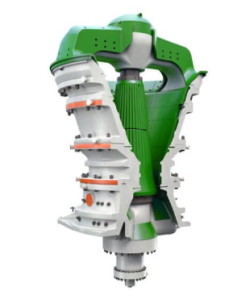
The ThyssenKrupp Kubria® series represents advanced single-cylinder hydraulic cone crusher technology, distinct from conventional multi-cylinder designs in critical aspects:
- Hydraulic adjustment system: Single large-bore hydraulic cylinder (180-280 mm diameter depending on model) provides continuous CSS (closed-side setting) adjustment under load, real-time product size control
- Tramp iron release mechanism: Hydraulic accumulator (nitrogen precharge 80-120 bar) allows 40-60 mm downward displacement when uncrushable material enters chamber, protecting components from shock overload
- Eccentric assembly: Direct-drive eccentric mounted on mainframe, elimevel gears found in gyratory crushers (reduces parts count by 35%, improves power transmission efficiency to 94-96%)
- Hydroset™ clearing system: Automated hydraulic clearing cycle reduces blockage clearing time from 4-6 hours (manual wedge removal) to 15-25 minutes
These design advantages create specific material and precision requirements for replacement parts that exceed those of conventional cone crushers.
Kubria® Model Range and Capacity Specifications
| Model | Feed Opening (mm) | Max Feed Size (mm) | Capacity Range (TPH) | Motor Power (kW) | Operating Weight (kg) |
|---|---|---|---|---|---|
| KB 36-50 | 915 | 215 | 135-360 | 200-250 | 16,800 |
| KB 48-65 | 1220 | 290 | 270-730 | 315-400 | 28,500 |
| KB 54-75 | 1370 | 325 | 390-1050 | 400-500 | 38,200 |
| KB 63-75 | 1600 | 380 | 540-1450 | 500-630 | 52,700 |
| KB 63-89 | 1600 | 380 | 650-1750 | 630-750 | 58,900 |
Critical Wear Parts Inventory and Replacement Intervals
Kubria® crushers require systematic replacement of wear components to maintain performance and prevent secondary damage:
Primary crushing chamber components (contact with material):
- Mantle (Main wear liner): Protects the head center assembly, subject to direct impact and abrasion
- Material: Mn18Cr2 or Mn22Cr2 austenitic manganese steel
- Weight range: 1,850-4,200 kg (model-dependent)
- Typical service life: 6,000-12,000 hours (basalt/granite applications)
- Replacement cost: €28,000-€67,000 per unit
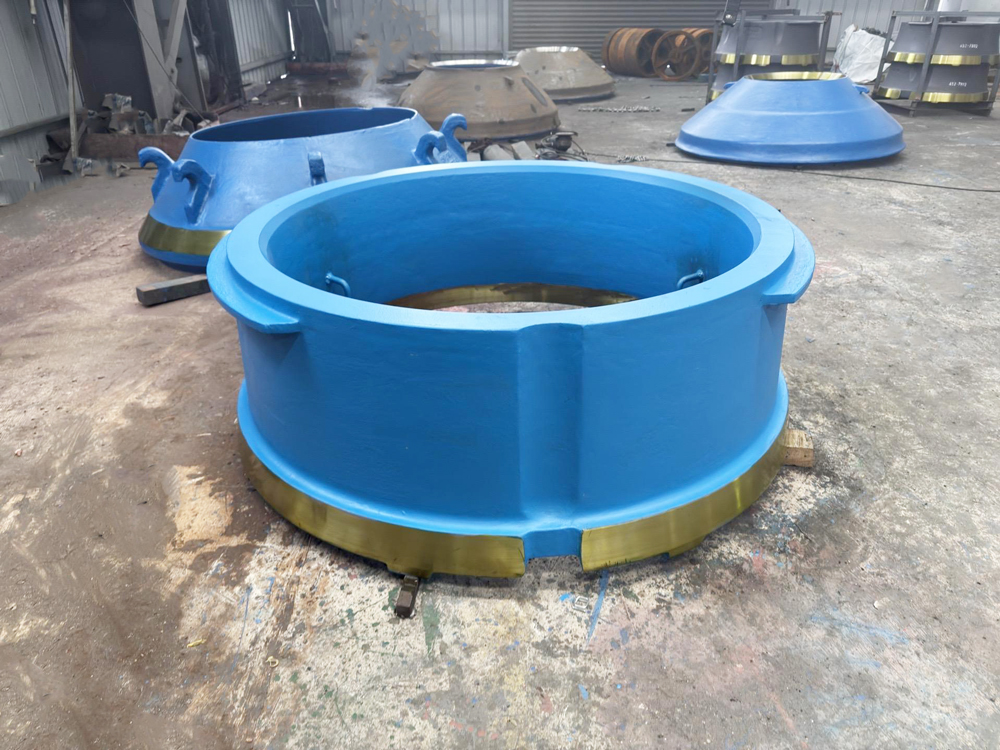
- Bowl liner (Concave): Fixed crushing surface mounted in mainframe bowl
- Configuration: Single-piece or segmented design (3-6 segments for larger models)
- Material: Mn18Cr2 standard, Mn22Cr2 for ultra-abrasive feeds
- Weight range: 2,400-6,800 kg complete assembly
- Typical service life: 8,000-15,000 hours (matched to mantle replacement ratio 1.2-1.4:1)
- Replacement cost: €42,000-€95,000 per assembly
- Feed plate (Distribution cone): Directs material flow into crushing chamber
- Material: Mn13Cr2 or Ni-Hard 4 (high-chrome white iron for extreme abrasion)
- Failure mode: Center breakthrough erosion after 4,000-8,000 hours
- Replacement cost: €6,200-€14,500
Mechanical wear components (friction surfaces):
- Head center bushing: Bronze bearing protecting mainshaft from eccentric assembly
- Material: C93200 leaded tin bronze or CuSn12 (DIN 1705)
- Critical dimension: Inner diameter tolerance H7 (e.g., Ø220mm +0.033/0 mm)
- Lubrication: Continuous oil bath, ISO VG 320 gear oil
- Replacement trigger: >0.5 mm radial wear or oil contamination Cu >80 >Eccentric bushing (Main bearing): Supports eccentric assembly rotation
- Material: High-lead bronze C93800 (14-16% Pb content for extreme load capacity)
- Design specification: Running clearance 0.25-0.40 mm radial (measured at 20°C)
- Failure consequence: Catastrophic—can destroy mainshaft (€85,000-€145,000 replacement cost)
- Monitoring: Weekly oil analysis for Fe and Cu wear metals
- Thrust bearing (Axial load bearing): Absorbs vertical crushing forces
- Configuration: Babbitt-lined steel backing (Sn-based alloy per DIN 1703) or polymer composite pads
- Load capacity: 1.8-2.5 MPa nominal bearing pressure
- Lubrication requirement: Minimum 3.5 L/min oil flow at 45-55°C
- Countershaft box components (gear drives on certain models):
- Pinion and gear set: 18CrNiMo7-6 case-hardened steel, AGMA Quality Class 10-11
- Countershaft bushings: Bronze CuSn12 or bimetallic bearings
- Service interval: Gear inspection every 8,000 hours, replacement at 35,000-50,000 hours
Dominant Failure Modes in Kubria® Crusher Operations
Failure Mode 1: Premature Mantle Plastic Deformation (High-Stress Applications)
Kubria® crushers operating in hard rock secondary crushing (granite, basalt, quartzite) subject mantles to peak contact stresses of 2.2-3.0 MPa during crushing events. Generic replacement mantles frequently fail via:
Root cause: Insufficient manganese content
- OEM specification: Mn18Cr2 (17.5-19.0% Mn, 2.2-2.6% Cr, 1.10-1.30% C)
- Common substitution: Mn13Cr2 (12.0-14.0% Mn, 1.8-2.2% Cr) to reduce material cost by 22-28%
- Work hardening deficit: Mn13Cr2 achieves surface hardness 420-480 HB under impact, versus 520-580 HB for Mn18Cr2 (measured via portable Leeb hardness tester after 500 operating hours)
Observable symptoms:
- Crushing surface develops concave wear profile (center section thins 8-15 mm more than top/bottom) after 2,000-3,500 hours
- CSS increases 6-12 mm without adjustment, reducing product quality (oversize material >nominal CSS increases from 8% to 22-35%)
- Power draw decreases 12-18% as effective crushing force diminishes due to enlarged gap
- Vibration amplitude increases from normal 3.2 mm/s to 5.8-7.5 mm/s as unbalanced wear creates eccentric loading
Field case—KB 54-75 in Swedish iron ore operation: Site procurement substituted Mn13Cr2 mantles after OEM parts lead time extended to 14 weeks. Initial cost savings: €12,400 per mantle. After 3,100 hours, ultrasonic thickness measurement revealed 28 mm center wear versus 11 mm at mantle top (design expectation: <15% thickness variation). Premature replacement required, plus unscheduled bowl liner replacement due to mating surface mismatch. Actual cost: €47,000 parts + €8,200 labor + 38 hours downtime = €114,300 total. Net loss versus waiting for OEM parts: €101,900.
Failure Mode 2: Bowl Liner Catastrophic Cracking
Segmented bowl liners in KB 63-75 and KB 63-89 models exhibit specific crack propagation patterns when material specifications deviate from OEM requirements:
Crack initiation mechanism:
- Through-bolt holes (M36-M42 fasteners, typically 18-24 holes per bowl liner) create stress concentrations where hoop stress reaches 1.8-2.3× nominal crushing stress
- If material lacks sufficient austenite stability (Mn content <17%), localized martensitic transformation occurs around holes during impact events
- Martensite formation (hexagonal ε-phase) is brittle: fracture toughness 18-25 MPa√m versus 60-85 MPa√m for austenite
- Crack initiates at hole edge, propagates intergranularly during thermal cycling (crushing chamber heats to 75-95°C during operation, cools to ambient during shutdowns)
Critical dimensional tolerances:
Dimension OEM Specification Failure Threshold Consequence of Deviation Mounting hole position ±0.20 mm from nominal >±0.50 mm Uneven bolt preload, localized stress 2.4× nominal Segment joint gap 0.5-1.5 mm (allows thermal expansion) <0.3 mm or >2.5 mm Binding (cracking) or material leakage between segments Crushing surface profile ±0.30 mm from CAD model >±0.80 mm Non-uniform load distribution, peak stress concentration Bowl liner thickness uniformity ±2.0 mm across full circumference >±4.5 mm Thermal stress from uneven heat conduction, warping Preventive inspection protocol:
- Magnetic particle testing (MT per ASTM E1444) at 4,000-hour intervals on high-stress areas (bolt holes, segment joints)
- Ultrasonic thickness gauging: Establish 12-point measurement grid per segment, track wear rate (normal: 0.6-1.2 mm per 1,000 hours in basalt)
- Thermal imaging during operation: Identify hot spots (>15°C above ambient average) indicating cracks or voids behind liner allowing heat accumulation
Failure Mode 3: Eccentric Bushing Seizure and Mainshaft Damage
The eccentric bushing failure mode is catastrophic, often requiring complete crusher rebuild:
Failure progression timeline:
- Initial phase (0-2,000 hours): Normal wear generates 15-35 ppm Cu in lubrication oil, establishes steady-state wear rate 0.008-0.015 mm per 1,000 hours
- Transition phase (2,000-3,500 hours with substandard bushing):
- If bronze alloy uses C86300 (Mn-bronze, 1-2% Pb) instead of specified C93800 (14-16% Pb), friction coefficient increases from μ=0.10 to μ=0.16
- Higher friction generates 35-60% more heat: Oil temperature rises from normal 58-62°C to 72-88°C
- Reduced lead content (solid lubricant) accelerates boundary lubrication breakdown during transient events (crusher start-up, tramp iron release)
- Wear rate accelerates to 0.045-0.080 mm per 1,000 hours, Cu contamination reaches 80-150 ppm
- Critical phase (rapid deterioration over 200-600 hours):
- Radial clearance opens from design 0.30 mm to 0.85-1.20 mm
- Oil film becomes unstable: Hydrodynamic lubrication intermittent, metal-to-metal contact occurs
- Adhesive wear (galling) initiates: Bronze transfers to mainshaft, creates built-up edge
- Cu contamination spikes to 250-450 ppm, Fe appears at 180-320 ppm (mainshaft erosion)
- Failure event (typically occurs suddenly):
- Thermal runaway: Bushing temperature exceeds 145°C, bronze loses 40% of strength
- Seizure: Bushing cold-welds to mainshaft, eccentric rotation drags bushing in housing
- Mainshaft surface damage: Scoring depth 0.8-2.5 mm, requires complete shaft replacement (€95,000-€165,000) or remetallization + grinding (€42,000-€68,000)
Actual failure cost breakdown (KB 63-75 incident):
- Emergency mainshaft procurement (air freight from Germany): €127,000
- Eccentric assembly overhaul (housing bore inspection + re-machining): €38,000
- Complete disassembly/reassembly labor (field service team): €52,000
- Replacement parts cascade (thrust bearing, head bushing, seals): €23,000
- Downtime (156 hours at 820 TPH capacity, $19/ton margin): €2,433,000
- Total: €2,673,000 ($2,890,000 USD)
Cause: €4,200 cost savings from using C86300 bushing instead of OEM C93800 specification. Cost amplification ratio: 635:1.
Material Specifications and Metallurgical Requirements
Austenitic Manganese Steel Grades for Mantles and Bowl Liners
Mn18Cr2 (ThyssenKrupp Standard Grade):
- Chemical composition (% by weight):
- Manganese: 17.5-19.0%
- Chromium: 2.2-2.6%
- Carbon: 1.10-1.30%
- Silicon: 0.30-0.60%
- Phosphorus: <0.07% (controlled to prevent embrittlement)
- Sulfur: <0.03%
- Balance: Iron
- Heat treatment protocol:
- Solution annealing: 1,050-1,080°C for 4-6 hours (section thickness dependent)
- Quenching: Water spray or immersion, achieve >50°C/minute cooling rate through 800-500°C range
- Target microstructure: >95% austenite, residual carbides <2% by volume, grain size ASTM 2-4
- Mechanical properties (as-delivered):
- Tensile strength: 720-850 MPa
- Yield strength: 400-480 MPa (0.2% offset)
- Elongation: ≥35% in 50 mm gauge length
- Hardness: 200-230 HBW (Brinell, 3000 kg load)
- Impact toughness: ≥45 J (Charpy V-notch at 20°C)
- Work hardening performance:
- After 500 hours operation in basalt: Surface hardness 520-580 HBW
- Depth of hardened layer: 8-15 mm (depends on impact energy and frequency)
- Mechanism: Strain-induced martensite transformation (TRIP effect—Transformation-Induced Plasticity)
Mn22Cr2 (Premium Grade for Extreme Applications):
- Manganese content increased to 20.5-23.5% for enhanced work hardening capacity
- Application: Quartzite, taconite, highly abrasive recycled concrete with improvement: 35-55% longer than Mn18Cr2 in abrasive applications (measured wear rate 0.42 mm/1000h vs 0.65 mm/1000h)
- Cost premium: 28-35% higher material cost, but justified by extended replacement intervals
- Heat treatment challenge: Requires two-stage annealing (1,100°C + 980°C) to prevent carbide network formation
Bronze Bearing Alloys for Sliding Components
Component Recommended Alloy Composition Key Properties Why This Matters Eccentric bushing C93800
(SAE 660)Cu 78%, Sn 7%, Pb 14%, Zn 1% PV limit: 2.1 MPa·m/s
Friction μ = 0.10
Max temp: 180°CHigh lead content provides emergency lubrication during transient overload events (tramp iron release cycles) Head center bushing C93200
(SAE 660)Cu 83%, Sn 7%, Pb 8%, Zn 2% PV limit: 1.75 MPa·m/s
Hardness: HB 65-75Balanced cost/performance for moderate contact pressure application Countershaft bushings CuSn12
(DIN 1705)Cu 88%, Sn 12% Higher strength: σb = 260 MPa
Hardness: HB 80-100Tin bronze (no lead) preferred where oil contamination must be minimized for gear lubrication Thrust bearing (Babbitt) Sn-Sb-Cu
(DIN 1703 L-SnSb12Cu6)Sn 80%, Sb 12%, Cu 6% Embeddability: absorbs debris
Conformability: tolerates misalignmentSoft bearing surface protects hardened steel thrust ring from scoring Critical manufacturing tolerances for bronze bushings:
- Inner diameter (ID) tolerance: H7 (e.g., Ø280mm = +0.046/0 mm) to ensure proper running clearance after assembly
- Wall thickness uniformity: ±0.8 mm maximum variation to prevent stress concentration during hydraulic installation
- Surface finish: Ra ≤ 1.6 μm on bearing surfaces (measured via profilometer) to support hydrodynamic oil film formation
- Cylindricity: ≤0.015 mm per 100 mm length to maintain even contact pressure distribution
OEM Parts vs. Engineered Aftermarket Parts: Performance and Economic Comparison
Three-Tier Supplier Quality Landscape
The ThyssenKrupp Kubria cone crusher parts market comprises three distinct quality tiers:
Tier 1: OEM (ThyssenKrupp Industrial Solutions):
- Material certification: Mill test certificates with full chemical analysis per DIN EN 10204 Type 3.1
- Dimensional accuracy: CMM inspection reports documenting ±0.15 mm tolerance achievement on critical surfaces
- Heat treatment verification: Time-temperature charts for every casting batch, microstructure photomicrographs
- Warranty: 12-18 months or 6,000-8,000 operating hours (whichever occurs first)
- Lead time: 10-16 weeks for mantles/bowls, 6-8 weeks for bronze components
- Price positioning: Baseline (index = 1.00)
Tier 2: Premium Engineered Aftermarket (ISO 9001 certified manufacturers with OEM-equivalent specs):
- Material: Identical alloy grades (Mn18Cr2, C93800) with independent laboratory verification
- Manufacturing: CNC machining post-casting, CMM dimensional verification (±0.20 mm typical)
- Quality systems: ISO 9001:2015 + industry-specific certifications (SFSA, NADCA)
- Technical support: Application engineering, wear analysis, installation assistance
- Warranty: 12 months or 5,000 hours
- Lead time: 6-10 weeks (faster due to predictive stocking of common models)
- Price positioning: 15-25% below OEM (index = 0.75-0.85)
Tier 3: Generic Commodity Suppliers (cost-optimized):
- Material: Frequently substitutes Mn13Cr2 for Mn18Cr2, C86300 for C93800
- Manufacturing: As-cast or minimal machining, dimensional tolerances ±0.60-1.20 mm common
- Quality documentation: Generic mill certificates without heat-specific data, no microstructure verification
- Warranty: 3-6 months, excludes consequential damages
- Lead time: 4-6 weeks
- Price positioning: 35-50% below OEM (index = 0.50-0.65)
- Hidden risk: 65-80% higher failure rate, 40-55% shorter service life based on multi-site failure data analysis
Total Cost of Ownership Analysis: KB 54-75 Case Study
Operational parameters:
- Material: Basalt aggregate production
- Capacity: 780 TPH in closed-circuit secondary crushing
- Annual operating hours: 5,400 hours (225 days × 24 hours)
- Product value: €18.50