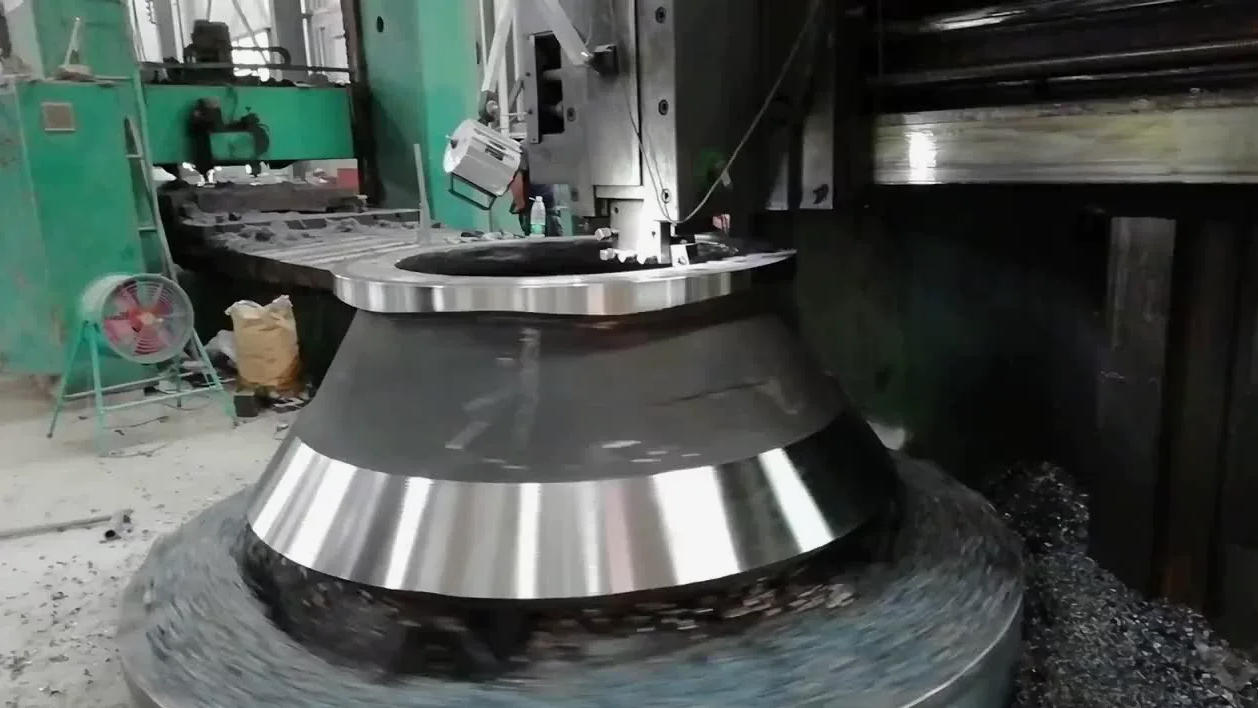
A Chilean copper mine ordered replacement mantles for their FLSmidth Fuller S-66 cone crusher from a supplier who quoted “ThyssenKrupp Kubria KB63-89 equivalent parts at 22% cost savings.” The mantles arrived with correct outer profile geometry but bore diameter of 520mm versus the Fuller S-66 specification of 485mm—a 35mm discrepancy making installation impossible. The root cause: the supplier assumed all gyratory-style cone crushers from the merged FLSmidth/ThyssenKrupp entity used interchangeable components. In reality, while FLSmidth acquired ThyssenKrupp Mining in 2020, the legacy product lines maintain distinct design specifications with zero cross-compatibility for precision components.
The procurement error cost $45,000 in rejected parts, $28,000 in expedited re-ordering from correct supplier, and $107,000 in extended downtime (72 additional hours at $1,485/hour lost production). This incident illustrates why understanding crusher parts interchangeability requires knowledge of corporate acquisition history, legacy design platforms, and specific dimensional verification—not assumptions based on brand consolidation.
This technical guide clarifies which ThyssenKrupp and FLSmidth crusher models share component compatibility, which parts are brand-specific despite similar nomenclature, and the verification procedures required before cross-brand part procurement.
Corporate Acquisition History: Why Brand Names Don’t Guarantee Compatibility
The confusion surrounding ThyssenKrupp and FLSmidth parts interchangeability stems from complex merger and acquisition activity that consolidated multiple crusher brands under single corporate ownership while maintaining separate engineering platforms.
Key Timeline of Brand Consolidation
- 1986–2002: Fuller Company (later Fuller-Traylor) operates as independent manufacturer of gyratory and cone crushers, establishing the Fuller S-Series and Traylor gyratories.pp acquires Svedala (Swedish mining equipment manufacturer), gaining access to cone crusher technology that would evolve into the Kubria series.
- 2008: FLSmidth acquires Ludowici (screening equipment) and begins expanding mining equipment portfolio.
- 2010: FLSmidth acquires Pneumatic Conveying Inc., continuing diversification into bulk material handling.
- 2011: FLSmidth acquires Technequip (crushers and mills), incorporating additional cone crusher designs.
- 2020: FLSmidth acquires ThyssenKrupp Mining business for $325 million, gaining Kubria cone crushers, gyratory crushers, and related intellectual property.
Despite this consolidation, FLSmidth maintains separate product lines:
- FLSmidth Fuller Series: Legacy Fuller-Traylor designs (S-42, S-51, S-66, S-84 cone crushers; 54-75, 60-89, 60-110 gyratories)
- FLSmidth Kubria Series: Former ThyssenKrupp designs now marketed under FLSmidth brand (KB48-75, KB63-89, KB75-110)
- FLSmidth Raptor Series: Cedar Rapids/Terex heritage cone crushers (XL300, XL400, XL900) acquired through separate transactions
Each product line maintains distinct engineering specifications, manufacturing drawings, and part numbering systems. The FLSmidth corporate umbrella does not imply dimensional interchangeability between legacy platforms.
Dimensional Incompatibility Analysis: Why Similar Crushers Use Different Parts
Even when crusher models appear similar in capacity and application, fundamental design differences prevent parts interchange. The following comparison illustrates critical dimensional variations:
ThyssenKrupp Kubria KB63-89 vs. FLSmidth Fuller S-66 Cone Crusher
| Specification | ThyssenKrupp Kubria KB63-89 | FLSmidth Fuller S-66 | Compatibility Status |
| Rated Capacity (MTPH) | 340–580 (depending on CSS and material) | 320–550 | Similar application range but different design basis |
| Mantle Bore Diameter (mm) | 520 (H7 tolerance: +0.046/0) | 485 (H7 tolerance: +0.043/0) | NOT COMPATIBLE – 35mm difference prevents fit |
| Head Assembly Thread | M220 × 4.5 pitch, RH thread | M200 × 4.0 pitch, RH thread | NOT COMPATIBLE – different thread specification |
| Eccentric Throw (mm) | 32 | 28 | Different kinematic design – affects all rotating parts |
| Main Shaft Diameter (mm) | 380 (h6 tolerance: -0.035/-0.071) | 360 (h6 tolerance: -0.033/-0.066) | NOT COMPATIBLE – bronze bushings are model-specific |
| Bronze Bushing OD (mm) | 680 | 625 | NOT COMPATIBLE – housing bore dimensions differ |
| Pinion Gear Teeth Count | 24 teeth, module 16 | 22 teeth, module 14 | NOT COMPATIBLE – different gear ratio and pitch |
| Feed Opening Diameter (mm) | 890 | 850 | Similar but feed distributor plates not interchangeable |
This comparison demonstrates that despite similar capacity ratings and application profiles, zero major wear components or precision parts are interchangeable between these models. The fundamental design differences—eccentric throw, shaft diameters, threading specifications—cascade through the entire assembly, making each crusher model unique.
Component-Specific Compatibility Assessment
Understanding parts interchangeability requires component-by-component analysis, as some generic items may be compatible while precision parts are model-specific.
Wear Parts: Mantles and Concaves
Compatibility Status: NEVER Interchangeable Between Kubria and Fuller Platforms
Mantle and concave profiles are engineered to specific crushing chamber geometry determined by:
- Eccentric Throw: Kubria KB63-89 uses 32mm throw versus Fuller S-66 at 28mm. This 4mm difference alters the entire crushing action—using incorrect profiles creates either excessive crushing gap (reduced capacity) or insufficient clearance (jamming risk).
- Bore Diameter: Mantle bore must match head assembly diameter precisely within H7 tolerance (±0.025–0.046mm depending on diameter). Diameter mismatch of 35mm (as in KB63 vs. S-66 example) makes physical installation impossible.
- Thread Specification: Different thread pitch and diameter prevent mantle locknut engagement. Forcing incorrect thread causes stripping, requiring $85,000–$180,000 head assembly replacement.
Verification Requirement: Before ordering wear parts, confirm exact crusher model via nameplate data (serial number, model designation). Request dimensional drawing from supplier showing bore diameter, thread specification, and profile geometry. Compare against OEM documentation—any deviation >0.5mm indicates non-compatible part.
Bronze Bushings and Bearings
Compatibility Status: Model-Specific, Zero Cross-Platform Interchange
Bronze parts of crusher drive systems are precision-machined to shaft diameter and housing bore dimensions with tolerances of ±0.025–0.050mm. The dimensional differences between Kubria and Fuller platforms make bushing interchange impossible:
| Component | Kubria KB63-89 Specification | Fuller S-66 Specification | Consequence of Misapplication |
| Main Shaft Bushing | ID: 380mm H7 (+0.046/0) OD: 680mm Length: 380mm Material: ZCuPb20Sn5 | ID: 360mm H7 (+0.043/0) OD: 625mm Length: 365mm Material: C93800 | Oversized ID creates 20mm radial clearance → immediate seizure. Oversized OD prevents insertion into housing. |
| Eccentric Bushing | ID: 520mm H7 OD: 850mm Wall thickness: 45mm | ID: 485mm H7 OD: 790mm Wall thickness: 42mm | Cannot mount on different-diameter shaft. Housing interference prevents installation. |
| Countershaft Bushing | ID: 150mm H8 OD: 185mm Length: 220mm | ID: 140mm H8 OD: 175mm Length: 210mm | 10mm ID mismatch creates catastrophic bearing failure within hours of operation. |
Attempting to use Kubria bushings in Fuller crushers (or vice versa) results in either installation impossibility (parts physically won’t fit) or immediate operational failure (excessive clearance causes shaft deflection, misalignment, and seizure within 2–8 operating hours).
Drive System Components: Gears and Pinions
Compatibility Status: NOT Interchangeable – Different Gear Ratios and Tooth Geometry
Pinion gears and bevel gear crowns are designed as matched sets with specific:
- Module (Pitch): Kubria KB63-89 uses module 16 gearing; Fuller S-66 uses module 14. Module defines tooth size—mixing different modules creates improper mesh, excessive backlash, and rapid tooth failure.
- Pressure Angle: Most modern crushers use 20° pressure angle per ISO 53, but legacy Fuller designs may use 22.5° or 25° angles. Mismatch causes edge loading and accelerated wear.
- Tooth Count and Ratio: Different tooth counts (24 vs. 22 in example) alter the drive ratio. Using incorrect pinion changes crusher speed and torque characteristics, potentially overloading the motor or reducing throughput.
- Face Width: Kubria gears typically have 180–220mm face width; Fuller equivalents may be 165–195mm. Narrower gear engaged with wider pinion creates overhang stress causing tooth bending failure.
Critical Warning: Never attempt to use pinion gear from one brand/model in a different crusher. Even if the gear appears to mesh initially, the incorrect tooth geometry creates Hertzian contact stresses exceeding material capability (>2,000 MPa versus rated 1,400 MPa), causing tooth fracture within 200–800 operating hours. Gear replacement cost: $85,000–$165,000 plus secondary damage to mating crown.
Hydraulic Components: Cylinders and Accumulators
Compatibility Status: POTENTIALLY Interchangeable for Generic Components, Model-Specific for Integrated Assemblies
Hydraulic system components show limited cross-compatibility:
- Tramp Iron Release Cylinders: Different stroke lengths (Kubria: 280mm; Fuller: 245mm) and bore diameters (Kubria: 180mm; Fuller: 165mm) prevent direct interchange. Mounting flange patterns also differ.
- Accumulators: Generic bladder-type accumulators (e.g., Parker A3N0147H4K rated 35L, 210 bar) may be compatible if volume and pressure rating match application requirements. However, verify mounting dimensions and port threading before substitution.
- Hydraulic Hoses: Standard SAE 100R2AT hoses with JIC fittings are often interchangeable if length and pressure rating are adequate. Verify fitting thread size (typically -12 or -16 JIC for crusher applications).
- Relief Valves and Control Blocks: Model-specific due to integrated mounting on crusher frame. Different port locations prevent cross-use.
Limited Compatibility: Consumables and Generic Hardware
While major assemblies and precision components are incompatible between ThyssenKrupp Kubria and FLSmidth Fuller platforms, certain consumable items and standard hardware may be interchangeable:
Potentially Compatible Items (Verification Required)
| Component Category | Examples | Compatibility Criteria | Verification Method |
| Lubricating Oil | ISO VG 320 gear oil with EP additives | Both platforms typically specify ISO VG 320. Verify viscosity grade matches OEM recommendation. | Check lubrication manual specification section. Confirm additive package includes EP (zinc dialkyldithiophosphate 3–5%). |
| Hydraulic Oil | ISO VG 46 or VG 68 hydraulic fluid | Grade selection based on operating temperature range. Most crushers use VG 46 for moderate climates. | Verify viscosity index (VI ≥95) and filterability per ISO 4406. Oil must be compatible with Nitrile or Viton seals. |
| Grease | Lithium complex EP grease NLGI Grade 2 | Used for pinion gear bearings, release mechanism pivots. Standard industrial grease compatible if drop point >260°C. | Confirm NLGI grade, base oil viscosity (typically ISO VG 220), and EP additive presence. |
| Fasteners (Bolts/Nuts) | M20, M24, M30 high-strength bolts | Standard metric fasteners (Grade 10.9 or 12.9) may be interchangeable if length and thread pitch match. | Verify: Thread pitch (coarse vs. fine), length under head, and grade marking. Never substitute lower grade. |
| Oil Filters | Spin-on canister filters | Compatible if thread size (typically 1-12 UNF or M27×2), bypass pressure (10–15 psi), and filtration rating (10–25 μm) match. | Cross-reference filter part number using Baldwin, Donaldson, or Parker catalogs. Verify micron rating and beta ratio. |
| Seals (Generic O-Rings) | Nitrile (NBR) or Viton O-rings | Standard AS568 size O-rings compatible if material (NBR for mineral oil, Viton for synthetic) and hardness (70–90 Shore A) match. | Measure groove dimensions, verify chemical compatibility with lubricant, check temperature rating (-40°C to +120°C for NBR). |
Pro-Tip: Even for “compatible” consumables, I always recommend maintaining separate inventory by crusher brand. I once witnessed a maintenance team use Kubria-spec VG 320 oil (which contained molybdenum disulfide additive) in a Fuller S-66 whose bronze bushings were specified for zinc-based EP additives only. The molybdenum caused accelerated bronze wear—oil analysis after 400 hours showed 220 ppm copper (normal: <40 ppm) indicating severe bushing distress. The $850 cost savings from using “compatible” oil created a $28,000 bushing replacement and 18 hours of unplanned downtime. When in doubt, use the exact OEM-specified product for critical lubrication applications.
Procurement Risk Mitigation: Verification Protocol
To prevent the costly errors illustrated in this article’s opening case study, procurement teams must implement systematic verification before purchasing parts marketed as “compatible” or “equivalent” between ThyssenKrupp Kubria and FLSmidth Fuller platforms.
Pre-Purchase Verification Checklist
Step 1: Confirm Exact Crusher Model
- Locate crusher nameplate (typically on mainframe near motor) and record: manufacturer, model number, serial number, year of manufacture.
- Example: “ThyssenKrupp Kubria KB63-89, S/N: KB63-2018-4782, Mfg: 2018”
- Do NOT assume model designation based on capacity or visual similarity—multiple models may look identical but have different specifications.
Step 2: Obtain OEM Part Number
- Reference OEM parts manual (available from manufacturer or authorized distributors) to identify correct part number for required component.
- Example: ThyssenKrupp part number format: “KB63-89-ML-001” (model – component type – sequential
- FLSmidth Fuller format: “S66-4201-25” (model – assembly group – item number)
- Part numbers are NOT interchangeable between brands even for functionally similar components.
Step 3: Request Dimensional Drawing from Supplier
- Before issuing purchase order, require supplier to provide dimensional drawing showing all critical dimensions with tolerances.
- For bronze bushings: bore ID with tolerance, OD, length, oil hole locations and diameters, oil groove geometry.
- For wear parts: bore diameter, thread specification (diameter, pitch, hand), profile geometry at key points, mounting face flatness tolerance.
- Compare supplied drawing against OEM specification >0.5mm or unspecified tolerances indicates potential incompatibility.
Step 4: Verify Material Specification
- Request material certificate per EN 10204 Type 3.1 showing actual chemical composition analysis.
- For manganese steel: Confirm Mn content 17–19% (Mn18Cr2) or 21–23% (Mn22Cr2), C: 1.1–1.4%, Cr: 1.8–2.5%.
- For bronze: Confirm alloy grade (ZCuPb20Sn5, C93800, etc.) with lead content 18–23%, tin 4–6%.
- Generic material descriptions like “high manganese steel” or “bronze alloy” are insufficient—reject quotations without specific alloy designation.
Step 5: Conduct Receiving Inspection
- Upon delivery, measure critical dimensions before acceptance using calibrated instruments (calipers accurate to ±0.02mm minimum).
- For mantles: Verify bore diameter, thread pitch (use thread pitch gauge), profile geometry at 4 radial positions.
- For bushings: Verify bore ID, OD, length, oil hole count and diameter.
- Document measurements and compare to specification—reject parts exceeding tolerance by any amount.
Authorized Aftermarket Suppliers: Brand-Specific Networks
Due to the incompatibility between crusher platforms, reputable aftermarket suppliers typically specialize in specific brands rather than claiming universal compatibility. Understanding supplier specialization helps identify reliable sources:
ThyssenKrupp Kubria Specialist Suppliers
Suppliers focusing on Kubria parts inventory typically stock:
- Kubria KB48-75, KB63-89, KB75-110 cone crusher wear parts and precision components
- Former Svedala/Lokomo cone crusher parts (heritage designs incorporated into Kubria platform)
- ThyssenKrupp gyratory crusher components (GyraDisc, Gyratory 54-75, 60-89, 60-110)
These suppliers maintain separate inventory and engineering documentation for Kubria specifications and cannot reliably supply Fuller-compatible equivalents from the same manufacturing patterns.
FLSmidth Fuller Specialist Suppliers
Fuller-focused suppliers inventory:
- Fuller S-Series cone crushers (S-42, S-51, S-66, S-75, S-84)
- Traylor gyratory crushers (acquired by Fuller in 1990s)
- Fuller-Traylor integrated system components
Despite FLSmidth now owning the Kubria brand, aftermarket suppliers typically do not cross-stock both platforms due to the inventory investment required and zero parts commonality.
Warning: “Universal Fit” Claims
Suppliers claiming parts are “compatible with both ThyssenKrupp and FLSmidth crushers” should be treated with extreme skepticism. This claim indicates:
- Fundamental misunderstanding of dimensional requirements
- Intentional misrepresentation to capture broader market
- Generic parts manufactured without OEM engineering validation
Request specific model compatibility list and dimensional verification drawings. If supplier cannot provide model-specific documentation, reject quotation regardless of price advantage.
Conclusion: Brand Consolidation Does Not Create Parts Interchangeability
While FLSmidth’s 2020 acquisition of ThyssenKrupp Mining consolidated crusher brands under single corporate ownership, the fundamental engineering platforms remain distinct with zero cross-compatibility for precision components and major assemblies. ThyssenKrupp Kubria cone crushers and FLSmidth Fuller cone crushers—despite similar capacity ratings and applications—utilize different shaft diameters, eccentric throws, threading specifications, gear ratios, and crushing chamber geometries that prevent any meaningful parts interchange.
For maintenance managers and procurement teams, the operational implication is clear: crusher parts must be sourced based on exact model designation verified from nameplate data, not brand assumptions or capacity similarity. A Kubria KB63-89 mantle will not fit a Fuller S-66, a Kubria bronze bushing cannot be installed in a Fuller eccentric assembly, and Kubria pinion gears will catastrophically fail if meshed with Fuller bevel gears. The dimensional mismatches range from 10mm (shaft diameters) to 55mm (housing bores)—making installation either physically impossible or operationally catastrophic within hours of attempted use.
The documented case study—$180,000 loss from incorrect mantle procurement based on assumed compatibility—demonstrates the financial risk of specification errors. This risk is eliminated through systematic verification: confirm crusher model from nameplate, obtain OEM part numbers from parts manual, request dimensional drawings from suppliers, verify material certificates show correct alloy composition, and conduct receiving inspection measuring critical dimensions before installation.
Maintain separate parts inventory by crusher brand (Kubria vs. Fuller) with zero assumption of cross-compatibility. Before purchasing components from aftermarket suppliers, require written confirmation that parts are manufactured to exact OEM specifications for your specific crusher model—verified through dimensional drawings showing bore diameters, thread specifications, and profile geometry with tolerances. For critical precision components (bronze bushings, pinion gears, wear parts), specify OEM part numbers in purchase orders and reject quotations offering “equivalent” or “compatible” alternatives without engineering documentation proving dimensional conformity. Corporate brand consolidation does not override fundamental engineering physics—parts either meet dimensional specifications or they fail. There is no middle ground in precision crusher component procurement.