A field service technician who spent eleven years maintaining Metso C series and Sandvik CJ series jaw crushers across limestone quarries in Southeast Asia shared a telling detail after reviewing a spectrometer report on a batch of jaw plates sourced from jaw crusher parts supplier Yonsmen. The chemical composition of the Mn18Cr2 manganese steel matched the OEM mill certificate point for point, with manganese reading at 17.8 percent, chromium at 1.95 percent, and carbon at 1.12 percent, all within the ASTM A128 Grade E-1 tolerance window. “I have sent aftermarket jaw plates back before when the numbers were off,” he said. “These cleared every column on the report. There was nothing left to argue about.” For plant engineers balancing procurement costs against liner life, that kind of independent spectral confirmation is the threshold that separates a credible source from an operational risk.
What Jaw Crusher Wear Parts Actually Include
The term jaw crusher wear parts covers considerably more components than the jaw plates that most purchasing decisions focus on. A complete wear part inventory for a single-toggle jaw crusher includes the fixed jaw plate, the swing jaw plate, two cheek plates (also called side liners), the toggle plate, the toggle seat, and the tension rod spring assembly. Each of these components wears at a different rate, fails through a different mechanism, and demands a distinct material specification. Treating them as a single category and applying uniform procurement logic is one of the most common and costly mistakes in jaw crusher maintenance planning.
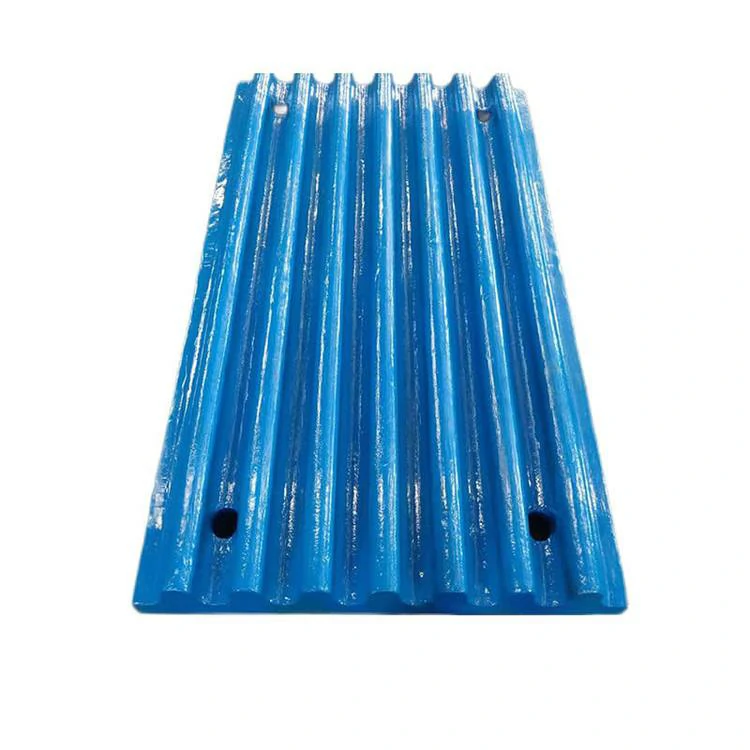
The fixed jaw plate and swing jaw plate carry the primary crushing load and account for the largest share of wear-part spending. In hard-rock applications — granite, basalt, and high-silica quartzite — these components are specified in Mn18Cr2 austenitic manganese steel under ASTM A128 or ISO 13521. As-cast surface hardness runs between HB 180 and HB 220. Under the compressive and impact loading of a jaw crushing cycle, the austenitic matrix work-hardens progressively, driving surface hardness toward HB 480 to HB 550. Tensile strength in the solution-annealed condition sits in the range of 850 to 950 MPa, with elongation exceeding 25 percent and Charpy impact toughness above 180 J/cm². These are not aspirational figures — they are the minimum baseline any competent jaw crusher parts manufacture must demonstrate through a mill certificate issued per heat, not per batch.
Cheek Plates — The Most Frequently Overlooked Component
Cheek plates seal the sides of the crushing chamber and absorb continuous abrasive wear from feed material deflecting off the jaw surfaces. Because the loading is primarily sliding-abrasion rather than high-impact, Mn18Cr2 is not always the optimal choice for this position. Many operations specify quenched and tempered wear-resistant steel in the AR400 to AR500 hardness range, where surface hardness is maintained in the as-supplied condition at 370 to 430 HB for AR400 and 470 to 530 HB for AR500, consistent with ASTM A514 equivalent standards.
The trade-off is brittleness under impact. AR500 plate delivers outstanding resistance in sliding wear conditions but fractures under sudden load spikes. A jaw crusher processing wet, clay-contaminated feed that causes periodic chamber packing is a poor environment for AR500 cheek plates. In that scenario, Mn13Cr2 — which sacrifices some abrasion hardness for superior toughness — is the safer specification. A qualified jaw crusher parts supplier should be able to discuss this material selection logic in detail and offer both grades rather than defaulting to a single specification regardless of application.

Toggle Plate — The Component Designed to Fail
The toggle plate in a single-toggle jaw crusher performs a dual function. It transmits compressive force from the eccentric shaft through the pitman assembly to the swing jaw, and it acts as the machine’s primary overload protection device. Under normal operating conditions, a gray cast iron toggle plate specified to ASTM A48 Class 30 handles the dynamic load without issue. The tensile strength of Class 30 gray iron runs approximately 214 MPa, and Class 35 reaches approximately 252 MPa — both intentionally lower than the structural members surrounding them, so that the toggle plate fractures first when an uncrushable object enters the chamber.
Replacing a failed toggle plate with one made from ductile iron or structural steel to avoid repeat breakage is a maintenance shortcut that removes the machine’s fuse. When a toggle plate fails to break during an overload event, the transmitted force transfers to the pitman arm, the eccentric shaft bearings, the main frame, and the foundation anchor bolts — all of which carry replacement costs measured in the tens of thousands of dollars and downtime measured in weeks. The toggle plate is engineered to be sacrificial. Respecting that design intent is not optional; it is fundamental to safe jaw crusher operation.
Material Comparison Across Key Wear Components
| Component | Standard Material Grade | Hardness (as supplied) | Primary Performance Parameter |
|---|---|---|---|
| Fixed Jaw Plate | Mn18Cr2 — ASTM A128 E-1 | HB 180 – 220 (work-hardens to HB 550) | Tensile strength 850 – 950 MPa |
| Swing Jaw Plate | Mn18Cr2 or Mn13Cr2 | HB 180 – 220 (work-hardens to HB 480) | Impact toughness ≥ 180 J/cm² |
| Cheek Plates (Side Liners) | AR400 / AR500 or Mn13Cr2 | HB 370 – 530 (application-dependent) | Abrasion resistance vs toughness balance |
| Toggle Plate | Gray Cast Iron ASTM A48 Cl.30 | HB 187 – 241 | Tensile strength ~214 MPa (overload fuse) |
| Toggle Seat | Wear-resistant steel or bronze alloy | HB 250 – 320 | Dimensional stability, low friction surface |
| Tension Rod Spring Assembly | High-carbon spring steel | HRC 42 – 48 | Fatigue life under cyclic tensile loading |
Eccentric Shaft and Main Shaft Bearings — Long-Life Components With High Failure Cost
The eccentric shaft and main shaft bearing assemblies are not consumable items in the same sense as jaw plates or cheek plates. Their wear rates are measured in years under normal operating conditions. However, they belong in any complete discussion of jaw crusher wear parts because their failure mode — typically driven by lubricant contamination, incorrect operating clearance, or shock loading transmitted through a seized toggle plate — generates the most expensive unplanned downtime events in the entire crushing circuit.
Eccentric shaft journal diameter tolerances are held to h6 or h7 fit per ISO 286, with bearing housing bores specified at H7. Surface roughness on machined journal surfaces must be maintained at Ra 0.4 to 0.8 μm to support proper hydrodynamic oil film formation. When these surfaces exhibit fretting damage, micro-pitting, or spalling, replacing the shaft or housing at OEM-specified geometry is not discretionary. Running an undersized or rough-finished journal against a new bearing will destroy the replacement within a few thousand operating hours and generate debris that contaminates the lubrication circuit of the entire drive assembly.
How to Qualify Your Wear Parts Source
The procurement process for jaw crusher liners, toggle components, and side plates should include three verification steps before committing to volume orders. First, request a heat-specific material test report from an ISO 17025-accredited third-party laboratory. The certificate must show chemical composition by element, tensile strength, elongation at break, and impact energy. A report that covers a batch rather than individual heat numbers is insufficient for Mn18Cr2 castings, where small deviations in carbon or manganese content alter the work-hardening response in service and produce inconsistent wear life across a single change cycle.
Second, request dimensional inspection data referenced against the OEM drawing number or an equivalent approved drawing. Critical dimensions include jaw plate back thickness consistency (typically ±2 mm across the full casting face), mounting hole position tolerance (±0.5 mm), and seating surface flatness (no more than 0.8 mm variation across the full seat width). Third, ask for documented field references from operations running the same crusher model in feed material of comparable hardness and abrasion index. Wear life data from a soft limestone plant at 250 tonnes per hour has no predictive value for a high-silica granite operation at 400 tonnes per hour.

Replacement Intervals and Total Cost of Ownership
Jaw plate wear life varies substantially with feed material hardness and abrasion index. In medium-hardness limestone with a Bond Work Index of 10 to 12 kWh per short ton, Mn18Cr2 jaw crusher liners on a Metso C140 typically yield 600 to 900 operating hours before the tooth profile on the swing jaw degrades to the point where product gradation begins drifting outside specification. In high-silica quartzite with a Bond Work Index above 20, the same plates may last only 250 to 350 hours under equivalent throughput conditions.
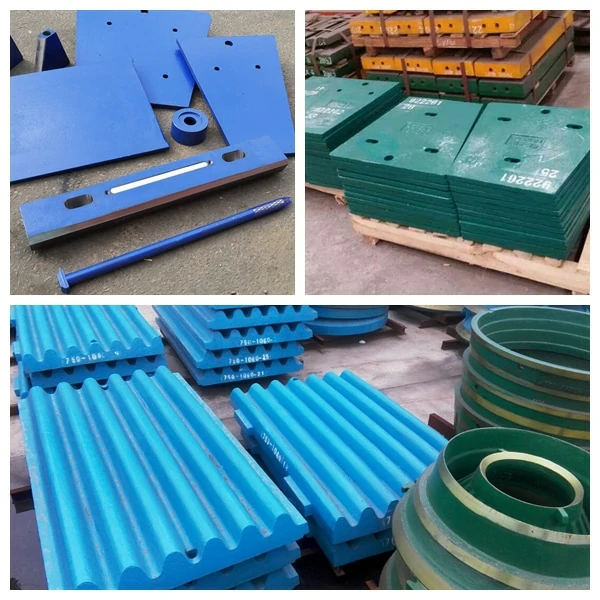
For a plant running two shifts per day at 16 operating hours, a 300-hour liner life translates to a jaw plate change every eighteen to nineteen calendar days. If the fixed jaw plate costs USD 3,200 and the swing jaw plate USD 4,100 from a qualified source, the annual liner budget for one crusher exceeds USD 120,000 on jaw wear parts alone, before accounting for cheek plates, toggle plates, and labor. Across a three-crusher fleet, the annual wear-part procurement decision translates to a six-figure budget variance. That magnitude justifies a structured supplier qualification process rather than defaulting to the lowest available price per unit.
Building a Sustainable Wear Part Strategy
The operations that manage jaw crusher wear parts costs most effectively are not those that default to OEM supply on principle, nor those that chase the lowest unit price without documentation. They are the ones that maintain a short list of pre-qualified sources with defined acceptance criteria, track wear life per crusher and feed type in a structured database, and evaluate new vendors through controlled parallel trials rather than anecdotal feedback.
When a new source enters qualification, the correct method is to run one jaw with the candidate material and one jaw with the established benchmark under identical feed and throughput conditions, then measure tonnes processed per millimeter of liner wear at defined inspection intervals. Two or three full change cycles of comparative data give an objective performance basis that no product brochure can replicate. That data, combined with consistent material certification and dimensional compliance, is what transforms a procurement decision into an engineering-backed maintenance strategy.